




Skip to content

Provide your presbyopia patients more clear near moments without compromising distance vision1,2

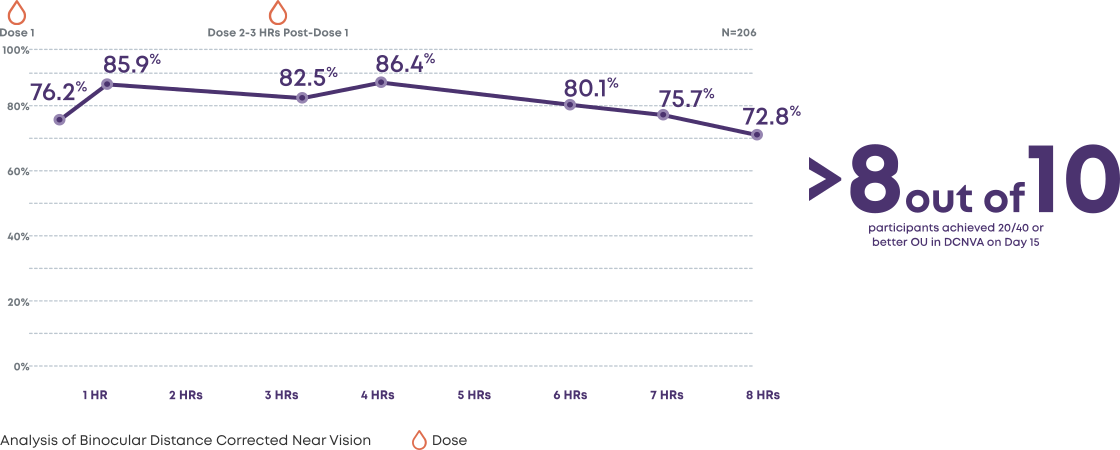
Nearly all patients experienced enhanced functional near vision (20/40 or better) on Day 153

Aeroplane copy
Primary Endpoint

Clear near vision—without compromising distance vision2

Clinical data from Day 8 and Day 15 demonstrate a consistent combination of efficacy, safety, and comfort, resulting in meaningful improvements in near vision1,2

40% of presbyopia patients on Qlosi achieved a ≥3-line improvement in DCNVA, and no loss of 1-line or more in distance visual acuity on Day 8 at 1 hour post-dose 1 vs those taking Vehicle (19%) (p<0.0001)2


DCNVA=distance-corrected near visual acuity


*Advise patients to exercise caution in night driving and other hazardous activities in poor illumination.

After 2 doses of Qlosi, functional near vision was extended for up to 8 hours3

Day 15—Subjects with DCNVA 20/40 or better in Study Eye (Monocular) vs Binocular Vision with all baseline subjects with 20/40 or better OU removed

Efficacy chart
Efficacy chart
 

DCNVA=distance-corrected near vision; OU=oculus uterque


See the Study Design below.


Helping patients see where Qlosi fits in

These quick questions can help identify when Qlosi is the right first choice.

When does blurry vision or your readers get in the way?

With Qlosi’s flexible dosing, patients can adjust treatment to fit their individual needs.1

Reference: 1. Qlosi [package insert]. Ponte Vedra, FL. Orasis Pharmaceuticals.

How often do you struggle to read in dim light?

Most patients notice improved clear near vision with Qlosi; Qlosi was tested in mesopic and low luminance lighting conditions.1,2

References: 1. Qlosi [package insert]. Ponte Vedra, FL. Orasis Pharmaceuticals. 2. Holland E, Karpecki P, Fingeret M, et al. Efficacy and safety of CSF-1 (0.4% pilocarpine hydrochloride) in presbyopia: pooled results of the NEAR phase 3 randomized, clinical trials. Clin Ther. 2024;46(2):104-113. doi:10.1016/j.clinthera.2023.12.005

Do you notice yourself needing brighter light or more distance to read comfortably?

By achieving an ideal pupil size, Qlosi helps patients see clearly up close without the need for extra light or readers.1

Reference: 1. Qlosi [package insert]. Ponte Vedra, FL. Orasis Pharmaceuticals.

Which hobbies or activities do you enjoy that require near vision?

Most patients achieve 20/40 functional near vision or better with Qlosi.1,2

References: 1. Cunningham D, Koetting C, Lang J. Comparison of monocular and binocular near vision improvement in the NEAR-1 and NEAR-2 phase 3 randomized, clinical trials: CSF-1 (0.4% pilocarpine HCl) for the treatment for presbyopia. Poster presented at AOA Optometry Meeting; June 21–23, 2024; Washington, DC. 2. Jackson M, Farid M. Pupil size reduction and percentage of participants achieving functional near vision in presbyopia: NEAR Phase 3 clinical trials. Poster presented at: American Academy of Ophthalmology 2025; October 18–20; Orlando, FL.

Does wearing readers affect your confidence?

With Qlosi, patients can see up close without reaching for readers, and with minimal risk of redness.1,2

References: 1. Qlosi [package insert]. Ponte Vedra, FL. Orasis Pharmaceuticals. 2. Holland E, Karpecki P, Fingeret M, et al. Efficacy and safety of CSF-1 (0.4% pilocarpine hydrochloride) in presbyopia: pooled results of the NEAR phase 3 randomized, clinical trials. Clin Ther. 2024;46(2):104-113. doi:10.1016/j.clinthera.2023.12.005

How disruptive would side effects like headache or redness be for you?

Qlosi is a miotic eye drop where in clinical trials, fewer than 10% of patients reported experiencing any single adverse effect.1

Reference: 1. Holland E, Karpecki P, Fingeret M, et al. Efficacy and safety of CSF-1 (0.4% pilocarpine hydrochloride) in presbyopia: pooled results of the NEAR phase 3 randomized, clinical trials. Clin Ther. 2024;46(2):104-113. doi:10.1016/j.clinthera.2023.12.005


Designed to meet the diverse needs of presbyopia patients2

Qlosi’s formulation and flexible dosing make it the ideal first choice for adults seeking clear near vision that fits seamlessly into everyday life

The NEAR-1 and NEAR-2 Qlosi clinical trials2

Study design
Study design

Examination of the retina is advised in all patients prior to the initiation of therapy.
aFor the first week, the second dose was administered 2 hours post-dose 1. For the second week, the second dose was administered 3 hours post-dose 1.


Primary endpoint:2

  • The primary endpoint was the achievement of a ≥3-line improvement (or 15 letter gain) from baseline in DCNVA at 40 cm with no loss in CDVA ≥1-line (or > 5 letter gain) at 4 m on Day 8 at 1 hour post-dose 1

Key secondary endpoints:2

  • Key secondary endpoints were the same criteria on Day 8 at 2 hours post-dose 1 and 1 & 2 hours post-dose 2
Key Inclusion Criteria:1
  • Age 45-64 years
  • Approximately between 20/50 and 20/160 Snellen in at least 1 eye*
  • MR between -4.50 and +2.00 D sphere in each eye with <2.00 D difference between eyes
  • <2.00 D of cylinder in each eye
  • ~20/20-2 Snellen or better CDVA in each eye
Key Exclusion Criteria:1
  • Prior refractive surgery or IOL implantation
  • Average dark-adapted pupillometry <3.5 mm in either eye
  • >7 letters improvement in post-vehicle treatment in monocular DCNVA in either eye at visit 1 (pretreatment) and visit 2 (pretreatment baseline)
*DCNVA ≥0.40 and ≤0.90 logMAR in at least 1 eye.
≤0.04 logMAR CDVA in each eye.
 

CDVA=corrected distance visual acuity; DCNVA=distance-corrected near visual acuity; IOL=intraocular lens; MR=manifest refraction; NEAR=Near Eye-vision Acuity Restoration

How to start your presbyopia patients on Qlosi

Important Safety Information

Expand

Indication and Usage


QlosiTM is indicated for treatment of presbyopia in adults.


Important Safety Information

Contraindications

Hypersensitivity


Warnings and Precautions

Advise patients to not drive or operate machinery if vision is not clear (e.g., blurred vision). Exercise caution in night driving and other hazardous occupations in poor illumination.


Rare cases of retinal detachment have been reported with miotics. Examination of the retina is advised in all patients prior to initiation of therapy. Advise patients to seek immediate medical care with sudden onset of flashes of lights, floaters, or vision loss.


Qlosi is not recommended to be used when iritis is present.


Qlosi should not be administered while wearing contact lenses. Remove lenses prior to the instillation of Qlosi and wait 10 minutes before reinsertion.


Avoid touching the tip of the vial to the eye or any other surface.


Adverse Reactions

The most common adverse reactions (5% to 8%) are instillation site pain and headaches.


Please see full Prescribing Information: here

References

  1. Qlosi [package insert]. Ponte Vedra, FL. Orasis Pharmaceuticals.
  2. Holland E, Karpecki P, Fingeret M, et al. Efficacy and safety of CSF-1 (0.4% pilocarpine hydrochloride) in presbyopia: pooled results of the NEAR phase 3 randomized, clinical trials. Clin Ther. 2024;46(2):104-113. doi:10.1016/j.clinthera.2023.12.00.
  3. Cunningham D, Koetting C, Lang J. Comparison of monocular and binocular near vision improvement in the NEAR-1 and NEAR-2 phase 3 randomized, clinical trials: CSF-1 (0.4% pilocarpine HCl) for the treatment for presbyopia. Poster presented at AOA Optometry Meeting; June 21-23, 2024; Washington, DC.
  4. AOA Focus. October 2023.